
Some links on this page are affiliate links, marked paid link. If you buy through them, we may earn a commission at no extra cost to you. Disclosure.
Best Electric Fence for Rotational Grazing: Energizers, Polywire, Posts, Reels and Grounding
How to choose an electric fence for rotational grazing: energizer sizing, polywire vs. polytape, step-in posts, geared reels and grounding, with sources.
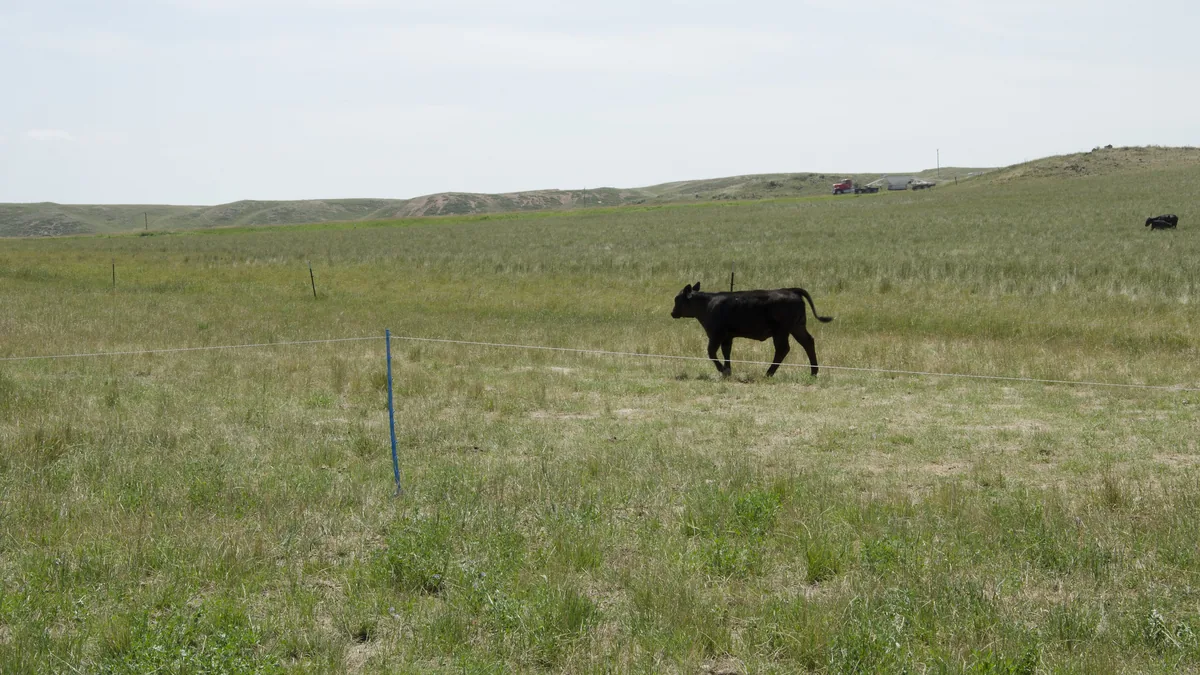

Rotational grazing lives or dies on the fence. A grazier who moves cattle every day or two needs a fence that goes up fast, comes down fast and still holds animals when the grass on the other side looks better. There is no single "best" electric fence, but there is a best system for a given herd, soil and paddock layout. This guide walks through the five parts of that system in the order ranchers usually get them wrong: the energizer, the conductor (polywire, polytape or braid), the posts, the reel and the ground.
Facts and list prices below were checked against the manufacturers' and Extension sources on November 11, 2026. Prices change, and dealers often sell below list.
How a portable grazing fence actually works
An electric fence is an open circuit. The energizer's fence terminal sends a short pulse down insulated wire, and its ground terminal connects to metal rods driven into the soil. Nothing happens until an animal standing on the ground touches the wire and closes the loop. Gallagher's Electric Fencing Basics puts it simply: a bird on the wire feels nothing because it isn't touching the ground.
Two things follow from that. First, the fence is a psychological barrier, not a physical one, so the pulse has to be strong enough every time. Virginia Cooperative Extension suggests keeping a minimum of about 5,000 volts for cattle and 7,000 volts for sheep on the line (Virginia Tech, SPES-689). Second, the ground is half the circuit. A weak ground makes even a big energizer perform like a small one.
1. The energizer (fence charger)
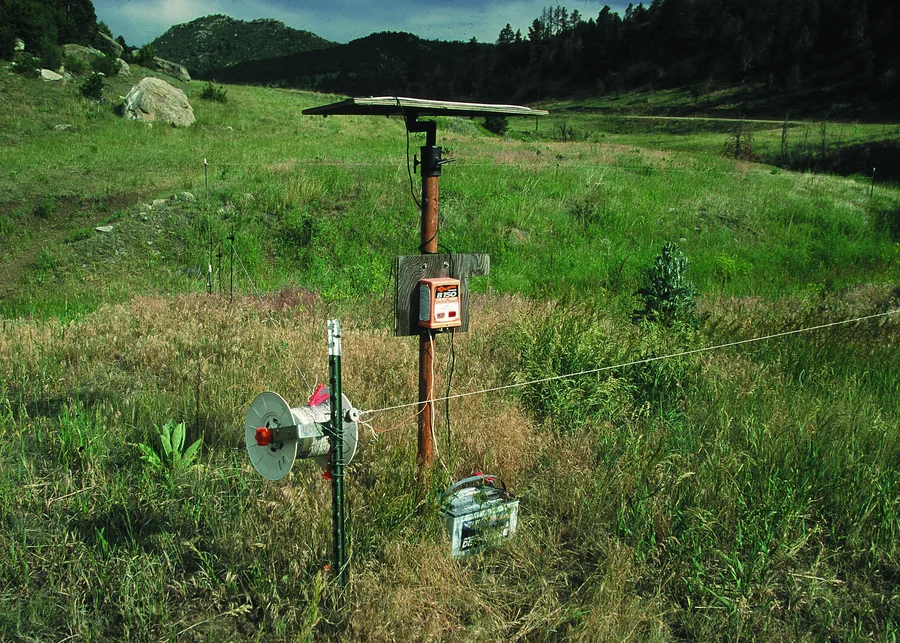

Size it by output joules and miles of hot wire
Box labels advertise acres and miles, but those ratings assume clean, ideal fence. Virginia Tech's Extension publication says no standard rating lets buyers compare energizers across brands, and that output joules are the best yardstick. Its rule of thumb is about one output joule per mile of fence (SPES-689). Michigan State University Extension cites the same guideline from the University of Missouri Forage Systems Research Center (MSU E3470).
The catch is counting every hot strand, not the fence length. MSU's worked example: a 15-acre rectangle with a 3,430-foot perimeter and three electrified wires carries 10,290 feet of hot wire, or about 1.9 miles, so the owner should buy a charger rated for at least two miles. Alabama Extension makes the same point: the acreage on the box is not a reliable guide, and fence length, strand count, livestock class and power source matter more (ACES ANR-3203).
Both Extension sources lean toward buying more energizer than the fence needs today. Heavy vegetation, dry soil and future paddocks all eat into the margin, and Virginia Tech notes that one of the biggest mistakes is an underpowered energizer.
Plug-in, battery or solar
- Plug-in (110-volt, "mains") units are the cheapest per output joule, according to Virginia Tech, and are the default wherever a grazier can run a lead-out from a barn or shop. As one example of list pricing, Gallagher's M360 Mains Fence Energizer is rated at 3.6 stored joules, "19 miles / 95 acres" of typical fence, with a US list price of $254.99.
- Battery and solar units go where the power doesn't. They suit remote paddocks and short, clean, single-strand subdivisions. Gallagher's S100 solar energizer manual lists 1.0 joule stored and 0.74 joules of output, which by the one-joule-per-mile rule is a small-paddock tool, not a perimeter charger.
A common setup is a plug-in energizer on the permanent perimeter, with the portable polywire subdivisions clipped onto it, and a solar unit kept only for out-paddocks far from power.
Stored vs. output joules. Stored joules are what sits in the capacitor. Output joules are what reaches the fence, and the number is always lower. Virginia Tech says stored joules can help compare models within one brand, but output joules are the better comparison across brands.
2. The conductor: polywire, polytape or braid
Portable conductors are plastic strands with thin metal filaments woven in. The metal carries the pulse, and the plastic carries the strength and visibility (Gallagher: temporary fencing for rotational grazing).
| Conductor | Best for | Trade-offs |
|---|---|---|
| Polywire | Daily paddock moves for cattle, sheep, goats and pigs; most rotational grazing | Least visible, but fits the most length on a reel and handles wind well |
| Polytape | Horses, or anywhere visibility matters | Bulkier on the reel, harder to rewind, wears faster, and catches wind and ice |
| Polybraid / polyrope | Longer or semi-permanent runs and windy sites | Costs more than polywire and is heavier to reel |
University of Maine Extension's materials trial reached the same conclusion: polytape is more visible, but a full reel of polywire builds more fence, and polytape wears out faster. Its advice is to use polytape where visibility matters (horses) and polywire for everything else (UMaine Extension). Gallagher adds that white tape shows up best against green or brown pasture, and brown or green tape shows up best against snow (Gallagher wire guide).
Conductivity matters more than strand count
The number to read on the label is resistance in ohms per kilometer. Lower resistance carries the pulse farther. Gallagher's own spec sheets show the gap:
- Its standard 1/16" Poly Wire has six stainless-steel strands at 6,000 ohms/km, and Gallagher recommends it for runs shorter than 656 feet. List price is $18.99 for 656 feet.
- Its 3/32" Turbo Wire mixes six stainless and three copper strands for 130 ohms/km, and Gallagher recommends it, or Turbo Braid, for anything longer than 656 feet. List price is $54.99 for 656 feet.
For a grazier strip-grazing a short paddock next to the energizer, cheap polywire is fine. For a subdivision a quarter-mile from the charger, or one that brushes tall grass, a low-resistance wire is usually cheaper than a bigger energizer.
3. Step-in posts
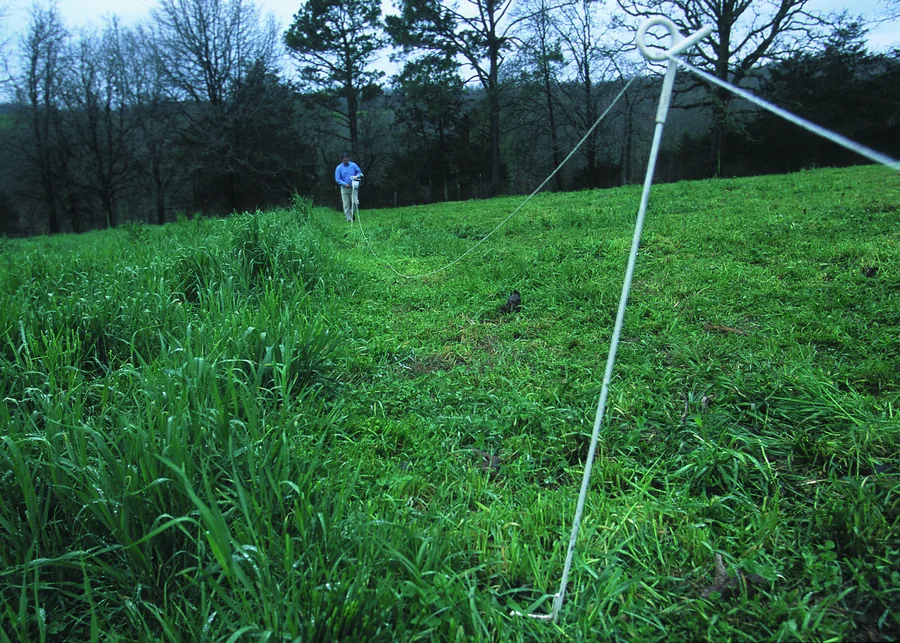

Most rotational grazers carry a bundle of step-in posts and push them in with a boot. Gallagher's Fencing 101 manual and the UMaine trial describe the main types:
- Plastic tread-in posts with molded loops at several heights. They're good for multi-strand fences (sheep and goats, or calves at the bottom wire) and for wetter ground. UMaine found them hard or impossible to install in very dry conditions.
- Pigtail and ring-top posts: a steel rod with a single curled or ring-shaped insulated head. They're fast to set, need no extra insulator, and suit single-wire cattle subdivisions. Gallagher sells its Ring Top Post as its best-selling temporary post in North America: 33 inches tall, a glass-reinforced nylon footplate, a 2-year warranty and a list price of $6.59 each.
- Fiberglass rods for lines that stay put for weeks. They last longer but have to be tapped in and need clips. UMaine notes the ends can splinter without a driving cap.
- Steel T-posts for corners and sharp turns, where flexible posts lean.
Spacing. There's no universal number. One grazier profiled by Gallagher spaces posts 50 to 70 feet apart on flat ground and closer on hills (Gallagher: Simple is best). Fewer posts means faster moves, as long as the wire stays at nose height through dips.
How many posts to buy: paddock side length ÷ post spacing, plus one, plus a spare handful. A 660-foot cross-fence at 60-foot spacing needs about 12 posts.
4. Reels and geared reels
A reel is what makes daily moves possible. Gallagher's rotational grazing article calls a reel essential for anyone who plans to move the fence (Gallagher).
Standard vs. geared. A standard reel winds one turn per crank. A geared reel winds several, which matters at the end of a long day:
- Gallagher's Geared Reel has a 3:1 gear ratio and holds 1,640 feet of Poly Wire, 1,312 feet of Turbo Wire, or 656 feet of tape, according to Gallagher's spec sheet. US list price is $116.99 reel-only or $249.99 pre-wound with Turbo Wire. Gallagher's Standard Reel lists at $109.99.
Since the price gap between a standard and a geared reel is small at list price, most graziers who move fence daily find the geared reel worth it. Note the capacity figures, too: a reel full of tape builds well under half as much fence as the same reel full of polywire.
Practical setup: run one reel per cross-fence. Leave one end anchored to the live perimeter or a "hot" lane wire, walk the reel out across the paddock, and hook the reel's insulated handle to a post or T-post at the far end. A second reel lets the next paddock be built before the herd moves (the "leapfrog" method), so the animals are never without a front fence.
5. Grounding: the part nobody budgets for
Gallagher's FAQ says 80% of electric fence problems trace back to inadequate grounding (Gallagher Electric Fence FAQ). Its minimum recommendation for a permanent energizer is:
- At least three galvanized steel ground rods, 6 feet long, spaced at least 10 feet apart
- Joined with one continuous galvanized wire clamped to each rod
- No copper rods or wire mixed with galvanized steel, because electrolysis corrodes the joint
Alabama Extension gives a related rule of thumb: at least 3 feet of ground rod per joule of energizer output, with rods spaced at least twice their length apart, set in soil most likely to stay moist and away from metal buildings (ACES ANR-3203). Bigger energizers need more rods.
Dry country. In dry, sandy or rocky soil, the animal may not complete the circuit through the ground at all. Gallagher recommends all-hot fences only where annual moisture is 35 inches or more. Elsewhere it suggests a hot/ground-return design, where alternating wires connect to the ground system so the animal touches both at once (Gallagher FAQ). Much of the arid West falls below that threshold, so many Western graziers run a ground-return wire on their perimeters.
Portable solar units come with their own short ground stake. It is worth driving it into the dampest spot nearby and checking voltage at the far end of the line, not just at the charger.
Putting it together: three sample setups
These are illustrations of how the rules above combine, not product endorsements. Costs vary by dealer and region.
- Small cow-calf herd, daily moves next to the barn. A plug-in energizer sized for the total miles of hot wire on the perimeter plus subdivisions, a three-rod galvanized ground at the barn, single-strand polywire cross-fences on two geared reels, and pigtail or ring-top posts at roughly 50–70 feet.
- Stocker cattle on leased ground with no power. A battery or solar energizer, with the one-joule-per-mile math done honestly. Low-resistance turbo wire or braid lets a smaller charger reach the far side, and the ground stake goes in the wettest spot available.
- Sheep or goats. Two or three strands on plastic tread-in posts with molded loops, or electric netting. Aim for the higher 7,000-volt target from Virginia Tech. For sheep producers on 50 acres or less, the Shepherdess paid link (Harmony Farms, Texas) sells a Grazing Sheep 101 video course and e-book paid link whose tutorials include fence charger and watering system installation.
Cost-share for fencing
Fence is an NRCS conservation practice (Fence, Practice 382), and EQIP can pay part of the cost of cross-fencing that supports a grazing plan. Regrarian Resource's EQIP application guide walks through the paperwork order, and the grant calendar tracks ranking cutoffs.
Where to shop
The Grazing & fencing section of the Regrarian Resource library lists fencing suppliers, linked plainly with no commission:
- Gallagher: energizers, polywire, reels and eShepherd virtual fencing
- Kencove: a wide electric fencing catalog with how-to content
- Pasture Systems: a grazier-run fencing and water supply shop
- Zareba Systems: budget chargers and supplies
Ranchers weighing collars instead of polywire can compare prices in the Virtual Fence Buyer's Guide. Before buying any fence, it helps to sketch the paddocks and recovery periods first with Your First Grazing Plan in One Afternoon.
Quick checklist
- ☐ Add up the total feet of hot wire, then divide by 5,280 to get miles
- ☐ Choose an energizer with at least that many output joules, plus headroom
- ☐ Use polywire for cattle and sheep subdivisions, low-resistance wire for long runs, and tape only where visibility matters
- ☐ Use step-in posts at about 50–70 feet on flat ground and closer on hills, with T-posts at corners
- ☐ Buy at least one geared reel per moving cross-fence
- ☐ Set three or more 6-foot galvanized ground rods, 10 feet apart, with no copper (more for big energizers, plus a ground-return wire in dry country)
- ☐ Test voltage at the far end of the fence: about 5,000 V for cattle, about 7,000 V for sheep
Sources
- Gallagher: Electric Fencing Basics, Electric Fence FAQ, Temporary fencing for rotational grazing, Wire guide, Fencing 101, and product spec pages linked above (list prices checked Nov. 11, 2026)
- Virginia Cooperative Extension, Electric Fencing: How to Select and Install an Energizer (SPES-689)
- Michigan State University Extension, Considerations for Selecting and Installing an Electric Fence Charger (E3470)
- Alabama Cooperative Extension System, Temporary Electric Fencing Equipment (ANR-3203)
- University of Maine Cooperative Extension, Temporary Electric Fence Materials Evaluation
- USDA NRCS, Fence (382) Conservation Practice Standard
Facts checked November 11, 2026.
Free: Grant Starter Kit
Checklists and templates for EQIP, SARE and Zero Foodprint applications.